
Photo by Tim Kuhn
Animal Privacy and Technology Project
Within interaction design literature, privacy has been an increasing concern, concomitantly with the increasing capabilities and pervasiveness of computing systems. The discourse on privacy more often than not disregards the implications that interactive technology might have for other animals who might come into direct or indirect contact with it. Some of the authors who have most influenced the discourse on privacy within computing and interaction design had recognised early-on that privacy is not an exclusively human phenomenon and that animals show a need for privacy in various circumstances. In particular, starting from the analysis of territoriality, Westin (1) and other privacy scholars, described basic privacy-claiming and distance-setting mechanisms manifested in both human and non-human animals.
With the increasing development and use of technology to manage animals in households, farms, zoos, research facilities and even wild environments, privacy considerations when designing such systems have become ever more important. For example, farmers who monitor their animals electronically face exposure to cyberbreaches and recognise the importance of data protection mechanisms. Typically, the motivation for developing cyber security and privacy protection mechanisms in animal contexts is still a need to protect data “owned” by humans, rather than a concern for the privacy of the animals themselves. However, cyberbreaches may indeed have a serious impact on animals' lives. For example, data captured from GPS collars fitted on protected wildlife can be intercepted, exposing tagged animals to the attack of cyberpoachers; in response, some have called for the development of security systems that cannot be easily hacked by poachers, so that the life of the animals, rather than the data “owned” by researchers, can be protected.
But, in a world where animals are constantly exposed to human technologies, are privacy concerns only limited to data security and bodily safety in the context of illegal practises or do animals have other privacy needs too? What privacy dynamics, if any, do animals manifest that might need to be taken into account when designing interactive systems which may affect them, or which are specifically designed for them? How might animal privacy be considered when designing technologically supported environments?
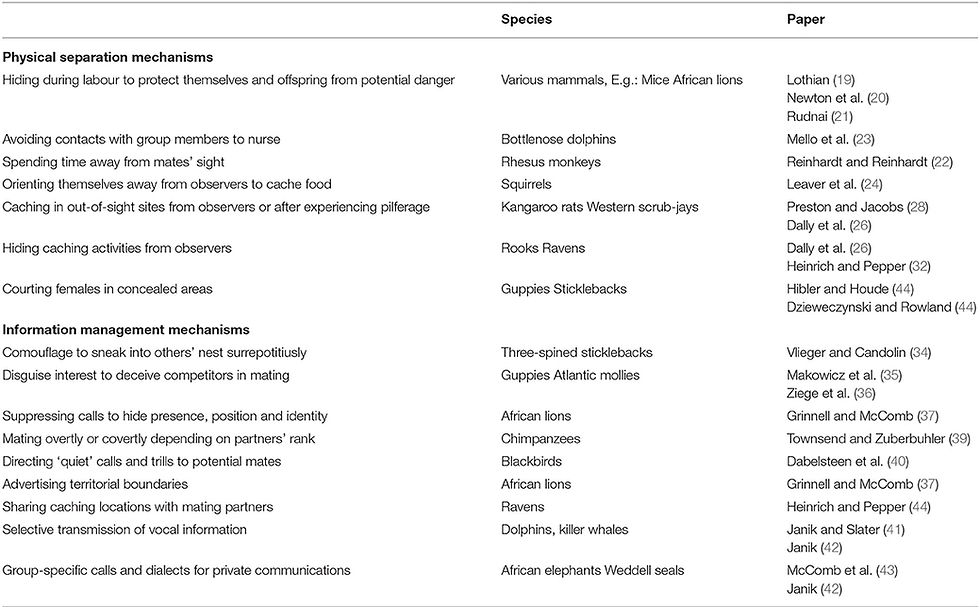
Animal-Computer Interaction researchers navigate uncharted waters when undertaking the challenge of designing technologically supported environments that might require consideration for animals' privacy needs. To better understand animal privacy, we analysed animal behaviour literature that could illuminate what privacy-related processes are manifest among animals. We based our analysis on the definition of privacy mechanisms provided by early literature on privacy and found that animals use a variety of privacy-related mechanisms, whose function is to secure their own and their assets' safety, as well as negotiate complex social interactions. In light of our findings, we questioned tacit assumptions and ordinary practises that involve human technology and that affect animal privacy. We did so by extending the notion of privacy to animals and discuss how animal-centred interactive systems could consider animals' privacy requirements.
The table below summarises different mechanisms that animals employ to manage their privacy and their functions:
To find out more, read the project's full publication.
Further reading
Paci, P., Mancini, C., Nuseibeh, B. (2022). The Case for Animal Privacy in the Design of Technologically Supported Environments. Frontiers in Veterinary Science 8:784794.